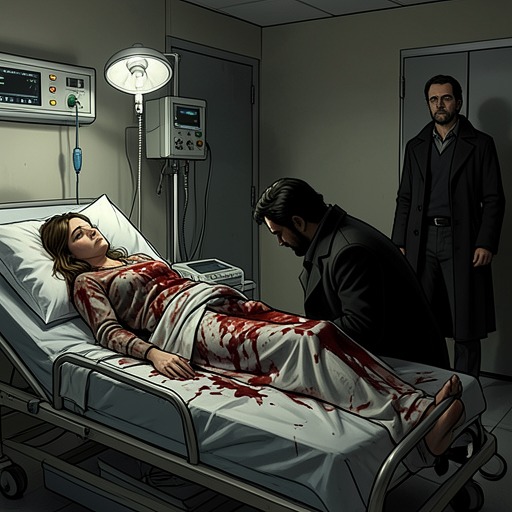
Jared tells Eve that her mother is dead and how she died
The RadleysJared Copeland tells Eve Copeland that her mother, Tess Copeland, is dead, not missing, and explains that she was murdered by her university tutor, whom he identifies as a vampire. The disclosure is both a revelation about Tess’s death and a test of whether Eve can trust a story her father has told before and later denied. Its force comes from that tension: Jared presents the account as truth, while Eve has learned to hear it as one of his episodes.
The kitchen and the disclosure
The conversation begins as Eve prepares to tell Jared that she is going out. She intends to behave as though her father has returned to his former self and as though she can make an ordinary decision as a seventeen-year-old. In the kitchen, however, she finds him eating directly from a jar of Lazy Garlic, already about three-quarters finished. The incongruity of the scene unsettles her expectation of a routine announcement; she even wonders whether he needs to return to hospital.
Jared interrupts that ordinary exchange to say he has something to tell her. When he says Tess is not missing, Eve initially cannot take in the meaning. She is used to tuning out her father’s rambling, and asks what he means. He then takes her hands and states plainly that Tess is dead. Eve closes her eyes and pulls away. The physical gesture marks her refusal to accept the news, while the jar and spoon remain in the scene as evidence of the mundane, compromised setting in which an extraordinary claim is being made.
Jared’s account of Tess’s death
Jared describes the killing as something he witnessed. He says he went to the university to collect Tess after she had told him she was working late in the library. When she was not there, he searched for her. He says he eventually saw her across a large body of water, ran through it, and watched her tutor bite and kill her before taking her away. His account therefore identifies a sequence as well as a cause: a late workday, Jared’s search, his sighting of Tess, and the tutor’s attack.
Eve questions the supernatural part of the account, but Jared insists that the tutor was not an ordinary person. He identifies him as a vampire and says the man took Tess’s blood and flew away with her. The event is presented through Jared’s testimony rather than through a separate scene of the murder. The distinction matters: in this conversation, the reader learns what Jared says he saw, while Eve’s uncertainty reflects the history that makes his testimony difficult for her to accept.
A story Eve has heard before
Jared’s disclosure is not the first time he has described Tess’s death in these terms. He had told Eve the vampire story while in hospital; afterward, it surfaced only when he was very drunk, and he later denied it, believing that he was protecting her. That pattern has taught Eve to treat the story as unreliable. She asks him not to continue and says that he should not be taking his tablets, interpreting the account as another sign that he is unwell rather than as a disclosure of fact.
The scene makes the delay in recognition central to the revelation. For a moment, Eve partly believes Jared; then, when he continues, she feels deeply hurt that he might be trying to manipulate her. His apparent composure changes the terms of the exchange: he puts down the spoon and speaks in what the narration presents as the voice of a rational adult. Yet that change does not instantly restore her trust. Her response is shaped by the earlier cycle of telling and retraction, so the truth arrives not as a clean break with the past but through the same account that has repeatedly been discredited.
Bishopthorpe and the immediate consequence
Jared says the attacker has come to Bishopthorpe and may already be dead, but that he still has to make sure. He takes Eve by the arm and tells her to remain in the house until he returns. This instruction gives the disclosure an immediate practical consequence: he does not merely explain Tess’s death but tries to keep Eve away from what he believes is a continuing danger.
He also tells her that the police are going to get the man. Jared says he has spoken to Alison Glenny, the woman who previously dismissed him for speaking about the truth, and has told her everything. He connects that report to having seen the attacker in a pub that day. Eve catches on the practical detail first, asking why he went to a pub when she thought they were broke. Her question leaves the exchange suspended between the supernatural danger Jared describes and the ordinary financial concern through which Eve still understands her father.
Significance of the revelation
The decisive change in the scene is from absence to death: Tess is no longer someone who might be missing but someone Jared says was murdered. The explanation also redefines the earlier story Eve had filed under illness, drunkenness, and denial. Nevertheless, the scene does not make trust effortless. Jared’s account gives Eve a location, a witness’s perspective, a motive for involving the police, and a warning to stay home, while her memory of his previous reversals keeps those details under suspicion.
The disclosure therefore functions as both family revelation and warning. Jared’s claim links Tess’s death to an attacker now in Bishopthorpe, and his plan to involve the police moves the conversation toward action. Eve, however, remains caught between hearing her father as a rational adult and recognizing the old pattern of a story she has been asked to disregard. The scene ends without resolving that conflict; it leaves his account, her distrust, and the danger he names pressing against the ordinary question of how he spent their money.